
Brain Rust


I read Sol Rashidi's LinkedIn post, and it grabbed and kept my attention. I thought I’d reshare it with you.
Is it possible that we’re all becoming Mediocre. Generic. Basic. And it’s happening Slowly. Quietly. Consistently.
In my hashtag#TEDx talks I’ve used terms like “Brain Rust” and “Intellectual Atrophy” and the indistinguishability that is setting in is
Not because you’re lazy.
Not because you’re busy.
But because you’re prompting.
But because 5% of the world and 1 in 5 Americans is using some form of AI and prompt engineering is becoming the new literacy.
“If I could just write better prompts, I’d be 10x more effective.” Thankfully, there’s no shortage of YouTube videos, influencers, and businesses trying to sell you on prompt instructions. And yes—there is a prompt for everything.
But here’s an uncomfortable truth:
The more you prompt, the more average you might perhaps become! Why?
Everyone is prompting the same models to generate the same outputs.
What starts as creative expression becomes intellectual atrophy 🧠 - your edge is slowly dulled by generative models because of reliance to think!
You prompt:
“Write a cold email that converts.” Thousands of others do the same.
The model gives you a solid result—and then you go back for more. And more. And more.
🧠Brain Rust sets in when we outsource thinking.
🤔 Intellectual Atrophy takes over when we stop questioning the process.
Prompting isn’t bad. But if your only strategy is prompting better…you’re becoming more average than you realize.
You don’t need better prompts. You need better thinking.
Are you training your mind—or just training a model?
My Take
I’m not sure I have anything incredibly insightful to add, other than emphasizing the following points—
🧠Brain Rust sets in when we outsource thinking.
🤔 Intellectual Atrophy takes over when we stop questioning the process.Are you training your mind—or just training a model?
I’ve been aligning my evolution to training my mind to avoid brain rust and intellectual atrophy. It’s one of the reasons I write so much content so frequently. It’s about sharpening my mind and my thinking. I also spend a solid amount of time reflecting each day, which is also the genesis of my writing.
As my friend Josh Anderson reminds me, we need to think of ourselves as a product.
The question is—how are you caring, feeding, growing, and evolving your product?
Stay agile, my friends,
Bob.
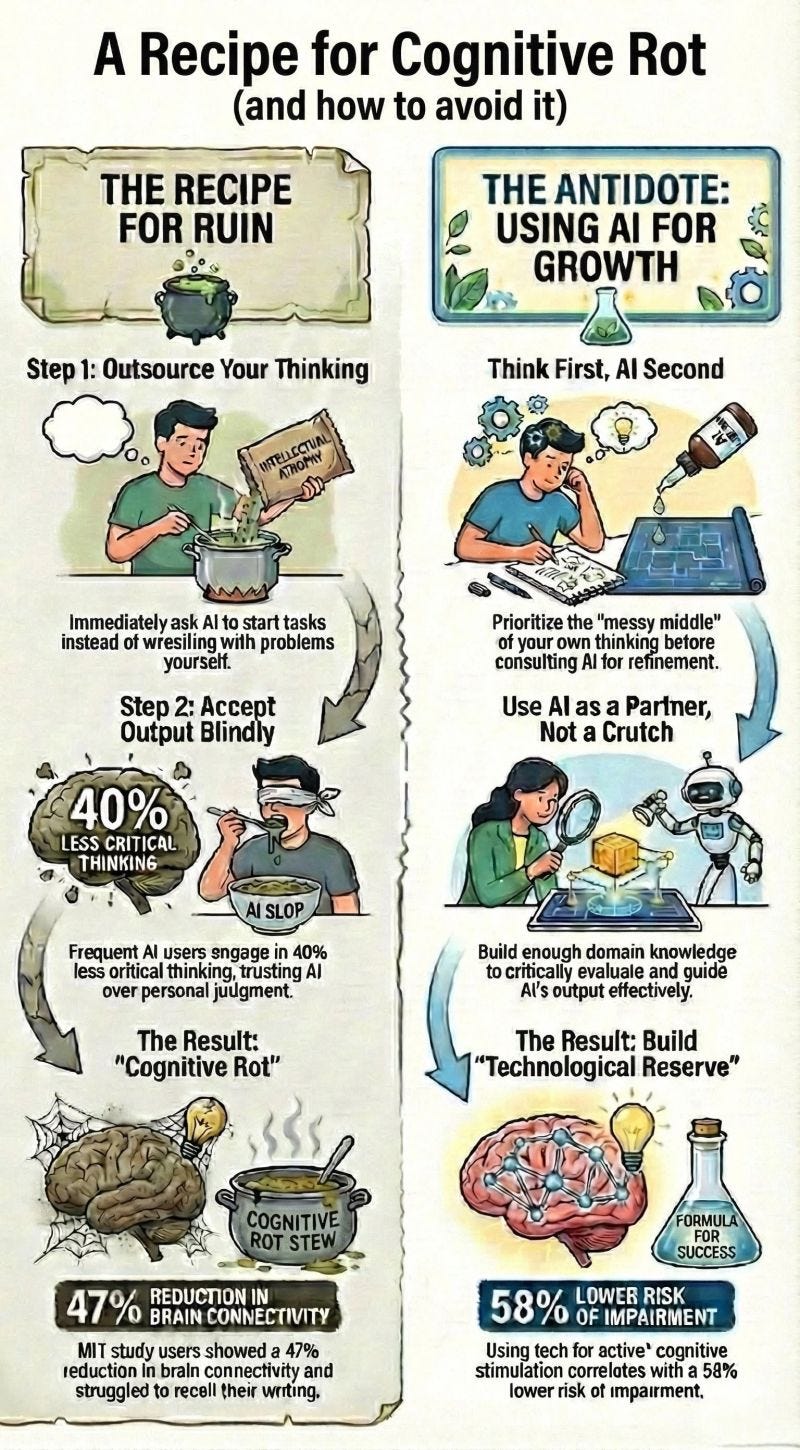
BTW: while this was in my writing Q, Dean Peters shared a post on LinkedIn about Cognitive Rot. It’s well worth sharing here, along with a graphic. Thank you, Dean!
Whatever your role or experience, life in the agile space can be challenging today. Having someone to serve as your coach, as a sounding board, be a truthteller, and become a trusted partner on tap to leverage during those tricky bits can be helpful. That’s precisely where Agile Moose can help you.
We’re not just an Agile Coach, but a business domain expert, a personal advisor, an organizational design and development consultant, and a leadership coach and partner.
The moose brings over 35 years of technical and product leadership experience across a broad range of contexts. If you’re stuck and know it, reach out, as I can help.
This piece nails something crucial. When everyone's drawing from the same well of prompts, there's a convergence toward average output that's kinda hard toavoid. I've noticed myself leaning too hard on models when brainstorming, and it definetly dulls that initial creative friction that leads to something interesting.